A magnetic chuck can only grip what the workpiece lets it grip. Five properties of the job decide how much of the chuck's force reaches it. Get these right and almost any job can be held for grinding, milling or EDM. Get them wrong and even a powerful chuck lets the job slide.
1. Contact area
Magnetic flux crosses from the chuck into the job through the contact faces. The ideal condition is the smallest possible air gap across the largest possible area. A job that touches the chuck only along a line or at a few points gives the poorest results.
2. Surface finish
Every scratch and peak on the contact face is an air gap. A lapped face holds best; an as-cast face holds roughly a quarter as well.
| Contact surface | Holding force |
|---|---|
| Lapped | 100% |
| Ground | 85% |
| Rough finish | 65% |
| Rough planed | 45% |
| As cast | 25% |
3. Workpiece material
Pure iron carries the most flux; stainless steel the least. These are the practical maximum grips Sarda measures on a standard chuck:
| Workpiece material | Grip (kg/cm²) |
|---|---|
| Cobalt iron | 26 |
| Mild steel (C < 0.25%) | 17 |
| Carbon steel (0.9% C) | 12 |
| Cast iron | 8 |
| Stainless steel SS 410/420 | 2 |
Martensitic stainless steels (SS 410/420) hold at only about 2 kg/cm². Use mechanical stops or pole extensions alongside the chuck for these jobs.
4. Heat treatment
Annealed material absorbs the maximum flux and keeps no residual magnetism after the chuck is switched off. Hardened material absorbs less flux and tends to stay magnetised, so plan for demagnetising after grinding. See removing residual magnetism.
5. Workpiece thickness
Flux travels from the centre of one pole to the centre of the next in a semicircular path. If the job is thinner than that path, it cannot absorb all the flux; the rest leaks into the air and the pull drops. Thin jobs need a finer pole pitch.
Direction of the cutting force
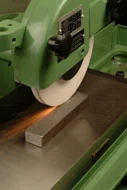
The grip is strongest when the cutting force acts at right angles to the poles. Downward force is four to five times the sliding force, so the more of the load that pushes into the chuck, the less likely the job is to slide. Consider how the grinding wheel or cutter meets the job when you set it out.
Which Sarda chuck for which job
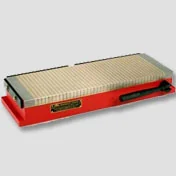
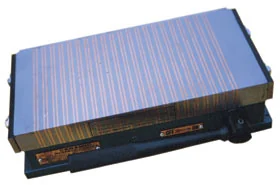
- KALYANI (standard pole, Art. 11101): general-purpose rectangular chuck for medium and thick jobs. Best grip from about 20 mm thick and 30 to 40 mm long. The top plate can be machined, drilled or grooved up to 12 mm deep. Typically about 6 kg/cm² on the pole area.
- PERMAFINE (fine pole, Art. 11103): a double magnet pack gives up to 10 to 12 kg/cm². With a pole pitch of about 6.25 mm it holds parts from 6 × 10 × 3 mm upward, and handles light milling.
- MICROFINE (microfine pole, Art. 11104): 2 mm steel and 1 mm brass poles for thin parts down to 0.5 mm in grinding.
- RADIAL (round, Art. 11206): radial NdFeB poles for rings, gears and hobs on grinders and lathes, with a through bore for spigots and coolant.
- EFINE (electro, fine pole): coils under every pole for horizontal and vertical surface grinders.
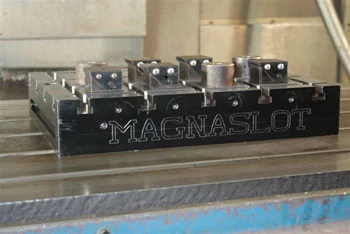
- MAGNASLOT: when the job needs milling, drilling or EDM, an electro-permanent chuck holds it magnetically or with clamps in its T-slots.